

Students scan printed atomic structure images using iPad to reveal interactive 3D atom models through Augmented Reality (AR), enhancing understanding of stable atomic structures.
1. Lesson Overview
School Level: Malaysian Secondary School
Subject: Science
Year / Form: Form 3
Topic / Unit: Chapter 8 – Radioactivity
Subtopic: 8.2 Atom and Nucleus
Curriculum Alignment: KSSM Science Form 3
- Content Standard: 8.2 Atom and Nucleus
- Learning Standard: 8.2.1 Draw an atomic structure in a stable state.
Duration: 60 minutes
Apple Technology: iPad, Apple Pencil, iPad Camera
Apps Used: Keynote, AR application with image-tracking capability
2. Learning Objectives
By the end of the lesson, students will be able to:
Identify the three subatomic particles: proton, neutron and electron.
- Describe the relative charges and locations of protons, neutrons and electrons.
- Explain that a neutral atom has an equal number of protons and electrons.
- Visualise and explain atomic structures using an interactive 3D AR model.
3. About the Learning Activity
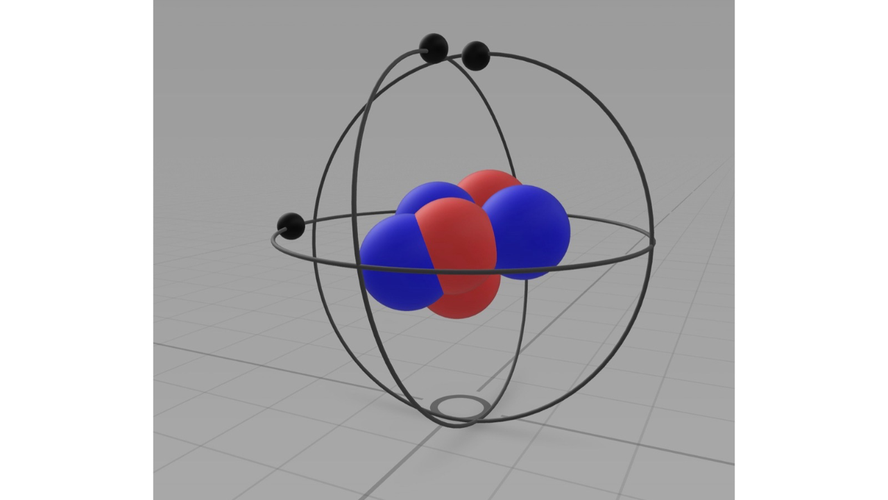
Scan & Discover: Atomic Structure in AR is an interactive science learning activity that combines printed learning images, iPad technology and Augmented Reality (AR).
The teacher prepares illustrated atomic structure images using Keynote. Each image serves as a visual marker that students scan using an iPad camera through an image-tracking AR application.
When the image is recognised, a corresponding 3D atomic model appears on the iPad screen. Students can observe the model from different angles, explore the nucleus and electron shells, and identify the arrangement of protons, neutrons and electrons.
This learning experience transforms abstract scientific concepts into interactive visual representations, allowing students to explore atomic structures in a more meaningful and engaging way.
4. Learning Activity
Explore – Scan and Discover (10 minutes)
- The teacher introduces the lesson by asking: “Can we see the structure of an atom with our naked eyes?”
- Students observe printed images of different atomic structures.
- The teacher demonstrates how to scan the image using an iPad and an AR application.
- Students observe how a 3D atomic model appears on the screen.
- Students identify the nucleus, protons, neutrons and electrons.
- The teacher guides students to understand the arrangement of particles in a stable atom.






Attach up to 5 files which will be available for other members to download.