

How can Grade 5 students design a device that safely delivers relief supplies to people affected by disasters?
After a strong typhoon, some families may be trapped on flooded rooftops or isolated patches of land. Roads may be blocked, and rescue vehicles or boats may not be able to reach them safely. In this STEM engineering design challenge, Grade 5 students were asked to design and build an aerial supply-drop device capable of safely delivering a fragile package to the ground.
The egg represented the relief package. The goal was to create a device that would fall slowly, stay stable, protect the package from impact, and land safely without harming people below.
The challenge was supported by design thinking because students first considered the needs of rescuers, medical teams, disaster relief organizations, and affected families. From there, they worked as young engineers: defining the problem, selecting materials, building a prototype, testing their design, studying what went wrong, and improving the device based on evidence.

A Human Need Behind the Engineering Problem
Although the project centered on engineering, it began with empathy. Students identified who they were designing for and why the device mattered.
Rescuers needed a reliable way to deliver supplies. Affected families needed food, medicine, or emergency items to arrive safely. By starting with the people affected by the problem, students connected their engineering decisions to a real human need.

Defining the Design Criteria and Constraints
Students defined the technical problem clearly: the drop device had to carry relief supplies securely and travel down from a height without damaging the package.
This gave students clear engineering requirements. Their device needed to slow the fall by increasing air resistance, stay balanced while falling, protect the package from cracking or breaking on impact, and use only the available materials.
The constraints made the challenge more realistic. Students had to think carefully about the purpose of each material and how the parts could work together as one system.

Pages as an Engineering Design Journal
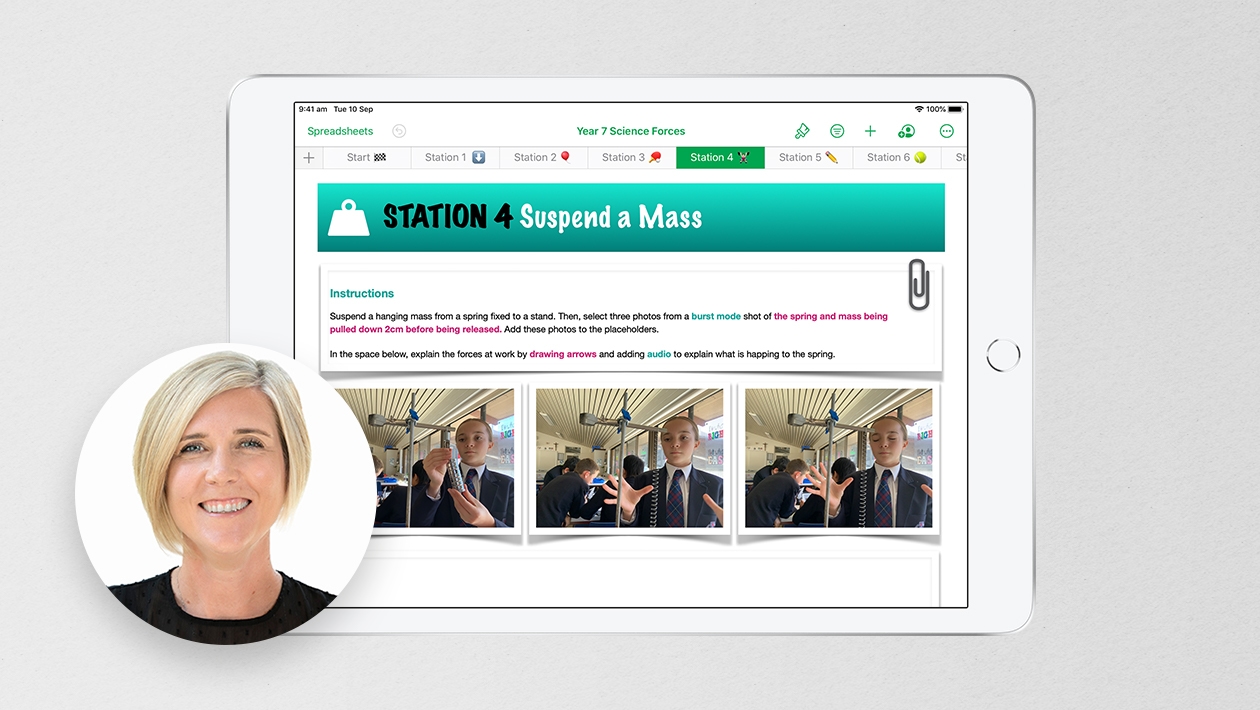
Students used Pages as their engineering design journal throughout the challenge. Instead of documenting their work on separate worksheets, they consolidated the entire process into one digital space.
In Pages, students inserted photos of their prototype, added sketches of their design, completed testing tables, and wrote explanations of their material choices. They also used drawing and annotation tools to label parts of their device, such as the parachute, frame, cup, cushion, and package holder.
Pages helped students document not only what they built, but how their thinking changed. Their journal became a record of the engineering process: understanding the problem, planning the design, building the prototype, testing the drop, revising the structure, and reflecting on forces.

STEM Learning in Action
As students planned and tested their devices, STEM became visible in every design decision.
In Science, students explored contact and non-contact forces. They observed how gravity pulled the device downward and how air resistance could slow the fall. They also considered how cushioning could reduce the impact on the package.
In Technology, students used an iPad and Pages to document their process through images, drawings, tables, videos, and written reflections.
In Engineering, students designed, built, tested, and improved a prototype using limited materials. They made decisions about parachute placement, structure, cushioning, balance, and stability.
In Mathematics, students applied spatial reasoning, measurement, proportion, and comparison as they adjusted the placement and connection of materials.
Through this process, students learned that a successful device depends on how well each part works with the whole system.
From Sketch to Prototype
Before building, students brainstormed and sketched possible designs. In one student sample, the group designed a prototype called the Alien Baby UFO.
Their design used a plastic cup to hold the egg, tissue to cushion it, straws to create a frame, yarn to connect the parts, and a plastic bag to act as a parachute. Each material served a purpose.
The plastic bag was chosen because it could catch air and slow the fall. The tissue helped protect the egg from cracking. The straws created a frame that lifted and supported the parachute. The yarn connected the different parts of the device.
This showed that students were not simply assembling materials. They were making engineering decisions based on function, structure, and safety.

Building and Testing the Drop Device
Students built their prototype and tested whether it could protect the egg during the drop. Using the iPad camera, they captured photos and videos of the testing process and inserted them into Pages as evidence.
The first trial did not succeed because the plastic bag did not catch enough air to slow the fall. Instead of treating this as a failure, students used the result as evidence. They reviewed their documentation, observed that the placement of the plastic bag affected how much air it could catch, and discussed how the design could be improved.
Before the second trial, they changed where and how the plastic bag was attached, moving it higher on the straw frame. This change improved the parachute. It caught more air, slowed the fall, and helped the egg land safely. On the second trial, the egg survived.


Improving Through Evidence
The strongest part of the challenge was the iteration. Students used what they observed during testing to improve their final design.
Their final design included a plastic cup for the egg, tissue for cushioning, straws as the frame, a plastic bag as the parachute, and yarn to connect the parts. Each material had a clear function. The cup held the package, the tissue reduced impact, the straws supported the structure, the plastic bag increased air resistance, and the yarn held the system together.
Pages helped students make this improvement visible. They were able to show the first design, document the failed trial, explain the change, and present the improved version.
Students learned that engineering is not about getting the first design right. It is about testing, learning from evidence, and improving the solution.

Sharing the Final Design
For the final reflection, students described their prototype and explained what they learned about forces. They connected their design to contact forces such as friction, applied force, and normal force, as well as non-contact forces such as gravity.
Students used photos and videos to show their prototype in action. They also explained why the first trial did not work, what they changed, and how the revised design helped the egg survive the drop.
The final Pages output showed both the product and the thinking behind it. Students communicated scientific understanding through an engineering solution.

Why This Matters
Aerial Supply Drop helped Grade 5 learners experience STEM as meaningful and connected to real life. They used Science to understand forces, Engineering to design and improve a working prototype, Mathematics to think about balance and structure, and Technology to document and communicate their solution.
The activity also showed students the value of empathy in engineering. A device is not successful only because it works technically. It becomes meaningful when it addresses people's needs.
Through this challenge, students learned that engineering is a process of designing, testing, failing, improving, and explaining. They saw that thoughtful design can help solve real problems, especially when people need safe and reliable solutions during emergencies.
Teacher Resource
A copy of the Aerial Supply Drop Engineering Design Challenge Pages template is available for download for teachers who wish to adapt the activity for their own STEM lessons on forces, motion, disaster response, prototyping, and engineering design.
.png)






May 30, 2026 . English
Love the Design Challenge!
This action is unavailable while under moderation.
This action is unavailable while under moderation.